


Quick answer: Bumble BFF is solid for browsing nearby profiles in dense metros, but the vast majority of matches never convert to real-world plans. Because it uses the same mechanics as dating apps - swiping, curated photos, and unstructured one-on-one DMs - it rewards profile optimization over actual connection. If you are exhausted by endless texting tennis and want to meet people in real life, plan-first apps that organize around real-time local activities convert far better.
Making friends as an adult in 2026 shouldn't feel like a high-stakes job interview.
Yet, anyone who has downloaded Bumble BFF to expand their social circle usually encounters the exact same cycle: you spend an evening swiping on aesthetic profiles, match with five seemingly cool people, exchange three rounds of "Hey! How was your weekend?", and watch the conversation silently die by Wednesday.
Nobody is hostile; nobody did anything wrong. The format simply runs out of road.
Bumble BFF remains one of the most recognizable names in the platonic connection space, backed by a 4.2-star App Store rating and millions of downloads. But downloads and actual meetups are two completely different metrics. By transplanting dating mechanics into platonic friendships, the platform created an unavoidable gap between matching on a screen and meeting in real life.
Here is an honest breakdown of how Bumble BFF works in 2026, where its structural limits leave users stranded, and what modern alternatives exist when you just want to get off your couch and hang out.
How the Bumble BFF Matching Process Works in 2026
Bumble BFF still relies primarily on the swipe-and-match model pioneered by dating apps.
Profile Building: You upload photos, write a bio, and pick badges representing up to five lifestyle interests (e.g., coffee, bouldering, techno, thrift shopping).
Browsing: You swipe through profiles one at a time, evaluating strangers on visual presentation and prompt answers.
The Wave/Match: If both people express interest, a match forms.
The Chat Window: You land in an empty, unstructured direct message window.
The Groups Pivot
Following its platform overhaul and the integration of community architecture, Bumble BFF introduced interest-based Groups alongside its classic one-on-one matching. Users can join topical channels or discover community hangouts.
While Groups was intended to separate platonic socializing from dating dynamics, the foundational experience remains profile-first. You are still asked to audition through personal marketing before anyone knows who you are in person. Crucially, even inside groups, the burden of initiating a meetup, picking the venue, setting a calendar date, and driving attendance falls squarely on individual users.
What Bumble BFF Gets Right
Bumble BFF is not without genuine merits, especially for newcomers arriving in a massive city:
Sheer Urban Density: In global hubs like London, New York, Los Angeles, and Berlin, Bumble BFF has unmatched brand recognition. If you open the app in central London, you will find active profiles within a few miles.
Photo Verification: The built-in selfie verification system remains an industry benchmark. It effectively filters out bots, spam accounts, and catfishing, giving users reasonable peace of mind regarding identity.
Low Financial Barrier to Entry: The core browsing and messaging features are free. While Bumble offers premium tiers for features like seeing who liked you first or extending match timers, you can technically use the app without paying.
Task-Oriented Utility: If you have an hyper-specific, short-term need—such as finding a running partner for Tuesday mornings or a gym buddy in your immediate neighborhood—the search filters can deliver fast matches if both users are proactive.
The Structural Flaws: Why the Match-to-Meetup Conversion Fails
Despite its reach, user communities consistently voice the same complaint: high match volume, near-zero actual meetups. The breakdown happens for structural reasons, not personal ones.
1. The Missing Escalation Path
Dating apps work because romantic tension has a built-in trajectory: match-> flirt -> date -> relationship. There is clear social incentive to move off the app.
Friendship does not work this way. Platonic connections form through shared context, proximity, and recurring low-pressure activities. Dropping two strangers into an empty direct message with nothing more in common than loving iced matcha creates awkward performance anxiety. There is no natural next step after "I love your style!", so conversations fizzle into polite silence.
2. The Unpaid Event Planner Burden
To turn a Bumble BFF match into an in-person hangout, one person has to step up, play logistics coordinator, propose a venue, negotiate schedules, and hope the other person does not cancel at the last minute.
Most people simply do not have the social energy after a workday to organize a stranger. If someone suggests "we should grab a drink sometime!", the lack of a concrete time and place guarantees the conversation will drift into the group-chat graveyard.
3. Swipe Fatigue and "Auditioning"
Curating photos and optimizing witty bio prompts selects for people who are great at personal branding—not necessarily people who make warm, reliable, fun friends. Evaluating human beings by flicking through glamour shots inevitably turns connection into an analytical exercise, training users to look for reasons to swipe left rather than reasons to meet.
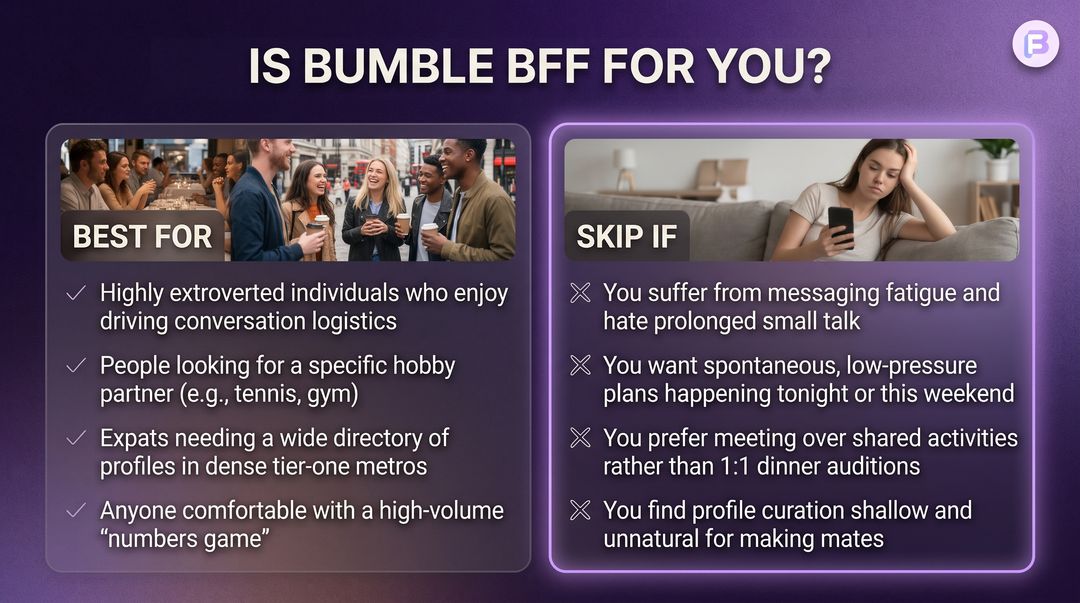
Who Thrives on Bumble BFF vs. Who Should Skip It
The 2026 Alternatives: Beyond Swiping and Profiles
The market has recognized the flaws of the dating-app clone model. As a result, three distinct categories of friend-finding tools have emerged in 2026:
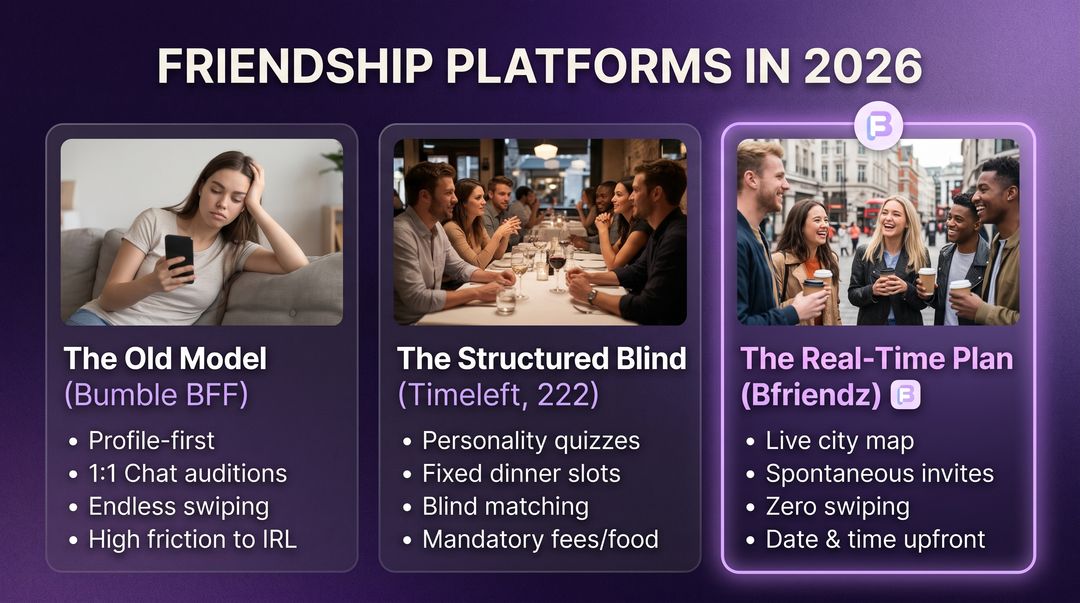
1. Bfriendz: Spontaneous Real-Life Plans on a Live Map
Instead of matching profiles first and hoping a plan materializes later, Bfriendz flips the equation entirely: you start with the plan itself.
How it works: Open the live interactive city map to see spontaneous, open invites happening nearby—someone grabbing coffee in 30 minutes, a group heading for pub drinks, people going to an exhibition, or a casual weekend walk.
The philosophy: Eliminates endless swiping and small talk loops entirely. Every invite already has a place, time, and specific activity. You simply review the plan, tap to join, and show up.
Why it converts: It bypasses the awkward 1:1 job interview vibe. Meeting over a shared casual activity takes the pressure off, letting connection develop naturally in the real world.
2. Timeleft: Algorithmic Group Dinners
Timeleft takes an institutional approach to solving planning friction by removing user choice entirely. You complete a personality questionnaire, pay a subscription/ticket fee, and are assigned to a Wednesday night table of 5–6 strangers at a mystery restaurant.
Pros: Zero planning burden; you simply arrive at the restaurant. Group dynamics mean no single individual carries the conversational weight.
Cons: Rigid schedule (only happens on fixed evenings), recurring subscription fees on top of an obligatory restaurant bill, and zero control over the activity or neighborhood vibe.
3. Meetup: Broad Topical Communities
Meetup remains the legacy platform for large group gatherings, hiking clubs, tech panels, and hobby circles.
Pros: Huge variety of established groups; often free or low-cost.
Cons: Broad, often formal, and heavily dependent on unpaid organizers. Walking into a room of 40 strangers can feel overwhelming, and events are rarely designed for spontaneous, last-minute hangouts.
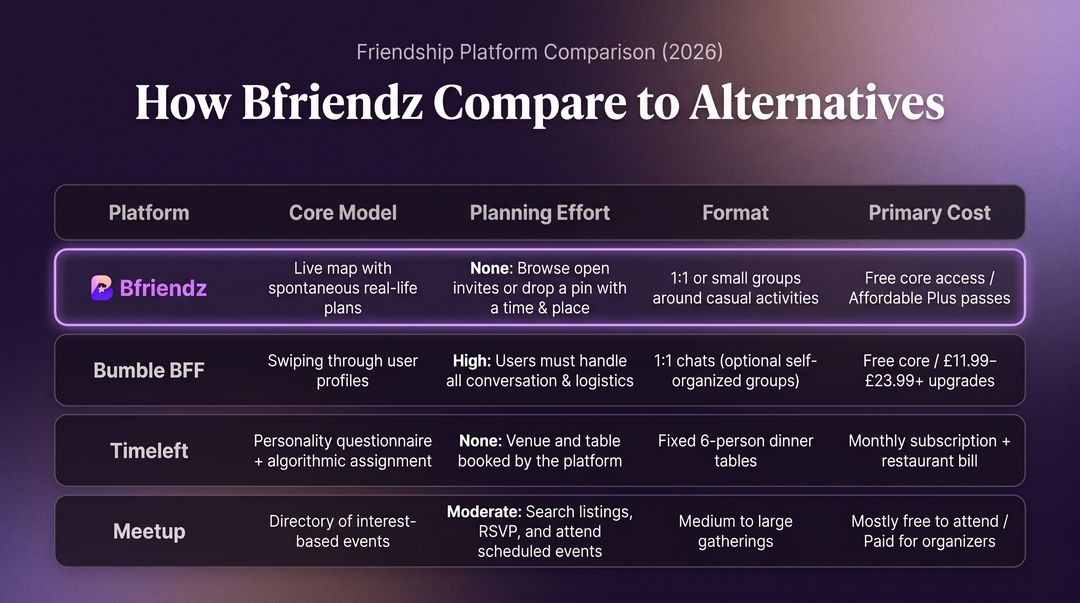
Feature Comparison
The Verdict: Is Bumble BFF Worth Your Time in 2026?
Bumble BFF is worth downloading if you have recently moved to a massive city, possess endless patience for text conversations, and enjoy treating social connection like a sales funnel. If you swipe on 50 profiles, message 15, and relentlessly follow up with concrete invitations, you can walk away with good connections.
However, if you are exhausted by matching with people who never leave the house, the problem is not your social skills - it is the app's architecture.
Friendships are not forged by evaluating photos and trading banter on a phone screen; they are formed by showing up to the same place, doing something unpretentious, and seeing if you click in real life. Stop saying "we should sort something out soon" to strangers on a dating app engine. Find a real plan, show up, and let the city do the rest.
Download Bfriendz

